HIPAA Compliance Automation with SigmaSRC
Protect patient health information and maintain HIPAA compliance with AI-powered automation. SigmaSRC enforces Security Rule safeguards, monitors PHI access, and provides continuous compliance evidence for healthcare organizations.
Understanding HIPAA Requirements
What is HIPAA?
The Health Insurance Portability and Accountability Act (HIPAA) establishes national standards for protecting sensitive patient health information. The law includes several key rules:
- Privacy Rule - Governs the use and disclosure of Protected Health Information (PHI)
- Security Rule - Establishes safeguards for electronic PHI (ePHI)
- Breach Notification Rule - Requires notification following a data breach
- Enforcement Rule - Outlines penalties for non-compliance
HITECH Act Requirements
The Health Information Technology for Economic and Clinical Health (HITECH) Act of 2009 strengthened HIPAA by:
- Extending requirements to Business Associates
- Increasing penalties for violations
- Mandating breach notification
- Promoting health IT adoption
The 2013 Omnibus Rule
The Omnibus Rule updated HIPAA and HITECH to:
- Expand Business Associate liability
- Strengthen individual rights
- Modify breach notification requirements
- Increase penalty amounts
HIPAA Security Rule Safeguards
Administrative Safeguards
| Requirement | SigmaSRC Capability |
|---|---|
| Security Management Process | Risk analysis, policy enforcement |
| Assigned Security Responsibility | Role-based access, audit trails |
| Workforce Security | Access authorization, termination procedures |
| Information Access Management | Access controls, clearance procedures |
| Security Awareness Training | Policy acknowledgment tracking |
| Security Incident Procedures | Incident detection, response workflows |
| Contingency Plan | Backup verification, DR compliance |
| Evaluation | Continuous compliance monitoring |
Physical Safeguards
| Requirement | SigmaSRC Capability |
|---|---|
| Facility Access Controls | Access logging, authorization verification |
| Workstation Use | Policy enforcement, configuration monitoring |
| Workstation Security | Endpoint protection, encryption |
| Device and Media Controls | Asset tracking, secure disposal documentation |
Technical Safeguards
| Requirement | SigmaSRC Capability |
|---|---|
| Access Control | Unique user IDs, automatic logoff, encryption |
| Audit Controls | Activity logging, log monitoring |
| Integrity | Data validation, alteration detection |
| Person or Entity Authentication | MFA enforcement, identity verification |
| Transmission Security | Encryption monitoring, secure protocols |
How SigmaSRC Addresses HIPAA
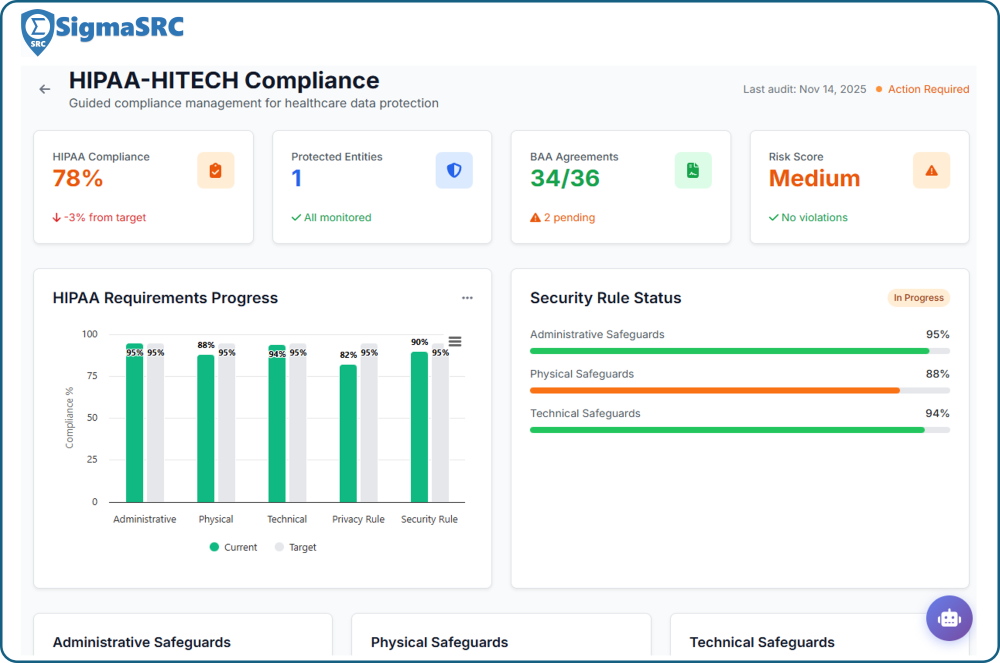
PHI Access Monitoring
SigmaSRC provides comprehensive PHI access visibility:
- Access logging - Track who accesses patient data
- Anomaly detection - Alert on unusual access patterns
- Privilege monitoring - Verify minimum necessary access
- Business Associate tracking - Monitor third-party access
Encryption Enforcement
Ensure ePHI is protected at rest and in transit:
- Disk encryption verification - Confirm all devices are encrypted
- Network encryption monitoring - Verify secure transmission protocols
- Key management - Track encryption key compliance
- Mobile device encryption - Enforce encryption on all endpoints
Audit Logging Automation
Meet audit control requirements automatically:
- Centralized log collection - Aggregate logs from all systems
- Log integrity - Prevent tampering with audit trails
- Retention management - Maintain logs per policy requirements
- Access reporting - Generate PHI access reports
Risk Assessment Tools
Conduct and maintain HIPAA risk assessments:
- Asset inventory - Identify all systems with ePHI
- Threat identification - Map current threat landscape
- Vulnerability assessment - Identify security weaknesses
- Risk scoring - Quantify risks to prioritize remediation
Business Associate Management
Track and document BA compliance:
- BAA tracking - Maintain agreement documentation
- BA security monitoring - Verify BA security controls
- Incident coordination - Manage BA-related incidents
HIPAA Compliance Workflow with SigmaSRC
1. Initial Risk Assessment
- Inventory all ePHI systems and data flows
- Identify threats and vulnerabilities
- Assess current control gaps
2. Control Implementation
- Deploy SigmaSRC agents to ePHI systems
- Configure HIPAA-aligned policies
- Establish access controls and monitoring
3. Continuous Monitoring
- Real-time compliance status tracking
- Automated evidence collection
- PHI access monitoring and alerting
4. Incident Response
- Breach detection and assessment
- Notification workflow management
- Documentation and reporting
5. Audit Readiness
- Generate compliance reports
- Prepare evidence packages
- Support OCR audit requests
Healthcare Industry Use Cases
Hospital Systems
- Protect patient records across departments
- Monitor EHR access and usage
- Secure medical devices and IoT
Healthcare IT Providers
- Demonstrate security to healthcare clients
- Meet Business Associate requirements
- Provide compliance evidence
Medical Device Manufacturers
- Secure connected medical devices
- Protect device data and PHI
- Meet FDA cybersecurity guidance
Insurance Companies
- Protect member health information
- Secure claims processing systems
- Monitor third-party access
Telehealth Platforms
- Secure remote patient consultations
- Protect video and messaging data
- Ensure transmission security
HIPAA Penalties
| Violation Level | Penalty per Violation | Annual Maximum |
|---|---|---|
| Did Not Know | $100 - $50,000 | $1,500,000 |
| Reasonable Cause | $1,000 - $50,000 | $1,500,000 |
| Willful Neglect (Corrected) | $10,000 - $50,000 | $1,500,000 |
| Willful Neglect (Not Corrected) | $50,000 | $1,500,000 |
Criminal penalties can reach $250,000 and imprisonment for willful violations.
HIPAA vs HITRUST
Many healthcare organizations pursue both HIPAA compliance and HITRUST certification:
| Aspect | HIPAA | HITRUST | Learn More |
|---|---|---|---|
| Type | Regulation | Certification framework | - |
| Requirement | Mandatory for covered entities | Voluntary | - |
| Assessment | Self-assessment or audit | Third-party certification | - |
| Scope | ePHI protection | Comprehensive security program | HITRUST Guide |
The SigmaSRC Platform supports both HIPAA and HITRUST compliance with unified controls and evidence collection.
Related Compliance Frameworks
Healthcare organizations often need multiple compliance certifications:
- HITRUST CSF - Comprehensive healthcare security certification that includes HIPAA
- SOC 2 - Required for healthcare SaaS and service providers
- NIST 800-171 - For healthcare contractors handling government CUI
- ISO 27001 - International standard for healthcare organizations
- PCI-DSS - Required if processing patient payments
- CIS Controls - Security benchmarks mapping to HIPAA requirements
Healthcare Industry Solutions
SigmaSRC serves the entire healthcare ecosystem:
- Healthcare Organizations - Hospitals, clinics, and health systems
- Healthcare IT Providers - EHR vendors and health tech
- Financial Services - Health insurance and claims processing
Explore solutions by organization size or role.
HIPAA Resources
Learn more about healthcare compliance:
- What is Compliance Automation? - How automation accelerates HIPAA compliance
- SigmaSRC Glossary - HIPAA, PHI, HITECH definitions
- SigmaSRC FAQ - Common healthcare compliance questions
Get Started with HIPAA Compliance
Ready to automate your HIPAA compliance program?
- Request a Demo - See SigmaSRC HIPAA automation in action
- View Subscription Plans - Find the right plan for your organization
- Explore the Platform - Learn about SigmaSRC capabilities
- Professional Services - Get expert HIPAA implementation support
- Contact Sales - Discuss your healthcare compliance needs